



If your child is becoming more short-sighted, you may notice that their glasses prescription seems to increase from one eye examination to the next. In the past, the usual approach was simply to prescribe stronger glasses. Today, we can do more.
At Stephen Davis Optometrists, we take a proactive approach to childhood myopia. Our aim is not only to help children see clearly today, but also to monitor how their eyes are developing and, where appropriate, discuss options designed to slow the progression of myopia.
What is myopia?
Myopia, commonly called short-sightedness, causes distant objects to appear blurred while close-up vision is usually clearer. It commonly develops during childhood and can progress as a child grows.
Myopia is more than simply a glasses prescription. Higher levels of myopia are associated with an increased lifetime risk of certain eye conditions, which is one reason why monitoring progression during childhood is important.
Current College of Optometrists guidance recommends discussing the long-term implications of myopia, relevant lifestyle factors and appropriate management approaches with families.
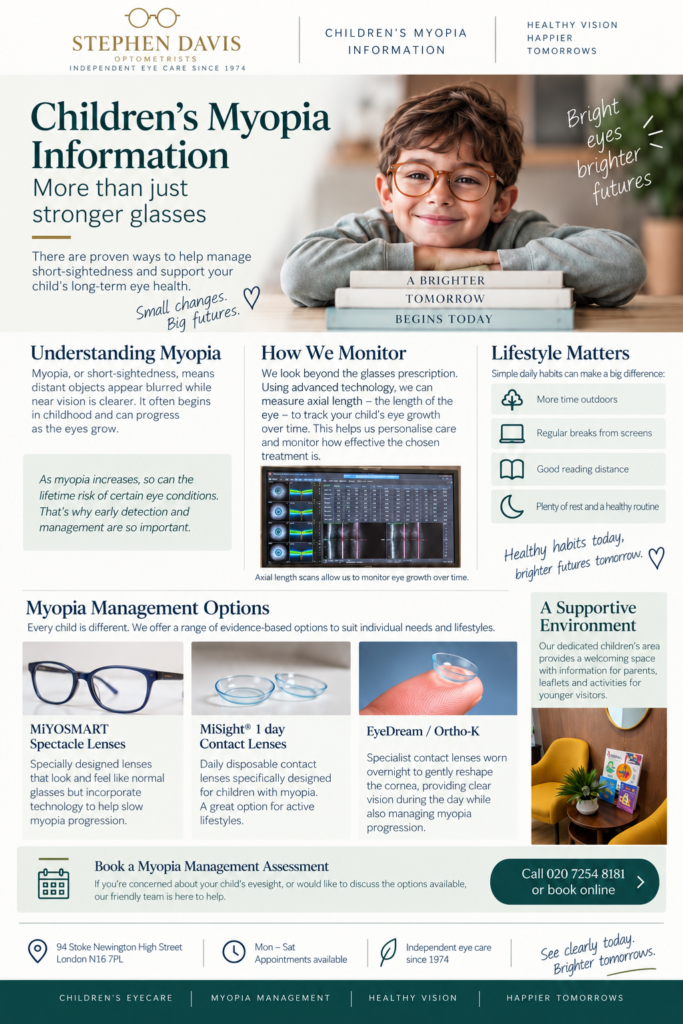
We look beyond the glasses prescription
An important part of our approach is axial length measurement.
Axial length measures the length of the eye from front to back. As a child’s eye grows longer, their myopia can increase. Measuring axial length gives us an additional objective way of monitoring eye growth rather than relying solely on changes in the glasses prescription.
Where clinically appropriate, we can take baseline measurements and monitor these over time to help us assess progression and response to treatment. The College of Optometrists specifically recognises biometry and axial-length measurement as methods that may be used when objectively monitoring children undergoing myopia management.
Myopia management options
Every child is different, so there isn’t one solution that is right for everyone. Following an assessment, we can discuss the options that may be appropriate for your child’s prescription, age, lifestyle and individual needs.
At Stephen Davis Optometrists, our options include MiYOSMART spectacle lenses, designed to provide clear vision while incorporating technology intended to slow myopia progression; MiSight® 1 day contact lenses, daily disposable contact lenses specifically designed for myopia management in children; and EyeDream/Ortho-K, specialist contact lenses worn overnight that gently reshape the cornea so that vision can be clear during the day while also providing a myopia-management effect.
These approaches are supported by a growing body of research. For example, long-term clinical studies have demonstrated sustained slowing of myopia progression and eye growth with MiSight® 1 day, while MiYOSMART’s DIMS spectacle-lens technology has also been extensively studied.
Lifestyle matters too
Myopia management isn’t only about lenses.
We talk to children and parents about everyday visual habits, including spending more time outdoors, taking regular breaks from prolonged close work and screens, and maintaining a sensible reading and working distance.
Time outdoors is particularly important in reducing the risk of children developing myopia, and international guidance commonly encourages school-aged children to spend around 1–2 hours outdoors each day where practical.
Making children’s eye care enjoyable
We understand that visiting the optometrist can feel very different for a child than it does for an adult.
Our practice has a dedicated children’s area with activities, children’s eyewear and information about short-sightedness and myopia management. We want children to feel relaxed and involved in looking after their own eyes, while giving parents the time and information they need to understand the choices available.
When should I ask about myopia management?
It is worth talking to us if your child is already short-sighted, their prescription appears to be increasing, there is a strong family history of myopia, or you simply want to understand their individual risk and the options available.
Myopia management cannot guarantee that a child’s prescription will stop changing completely. The objective is to slow progression where possible, while continuing to provide clear vision and carefully monitoring the child’s eye development.
Concerned about your child’s eyesight?
Speak to our team about a Myopia Management Assessment.
Stephen Davis Optometrists
Independent eye care since 1974